
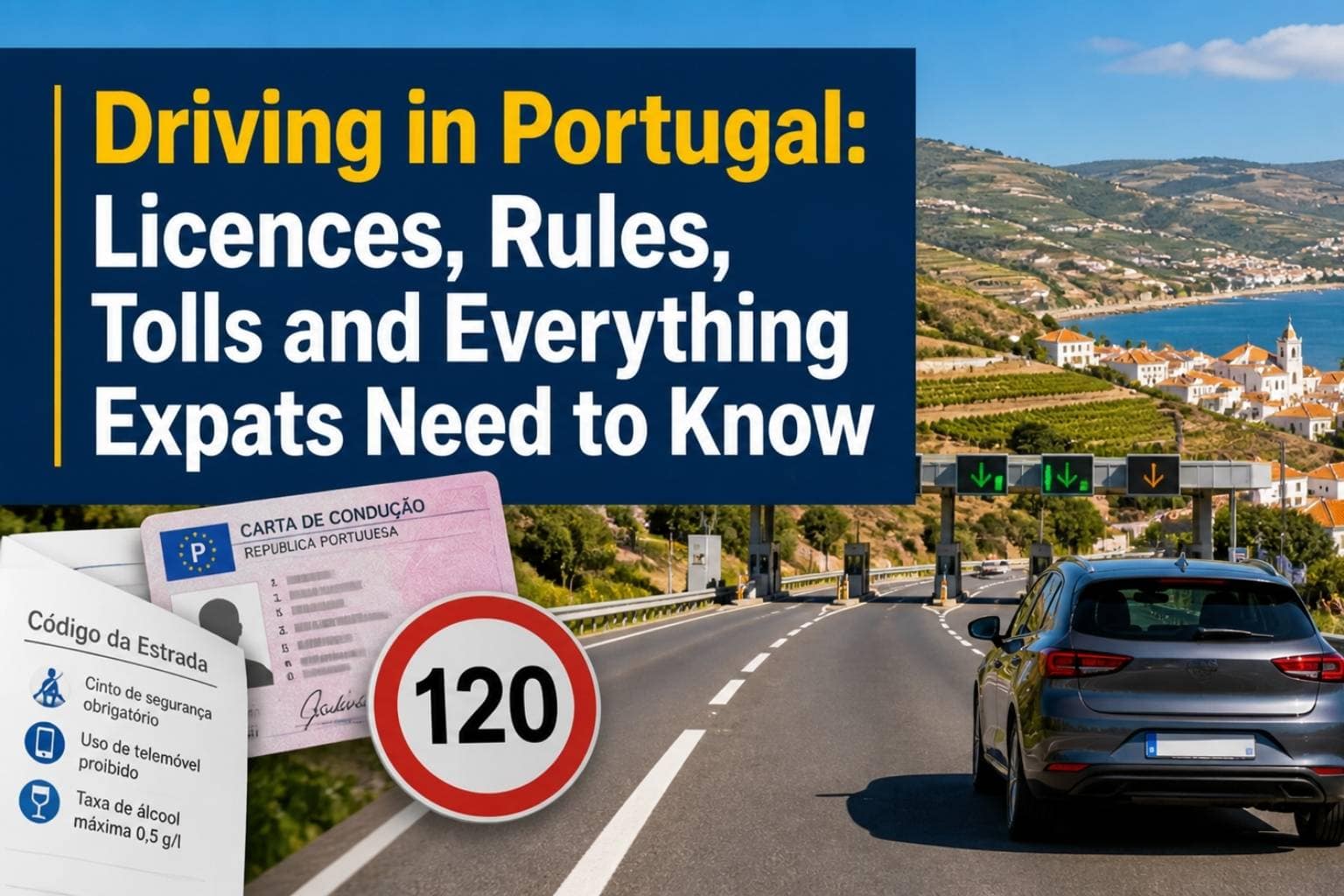
One of the first practical questions people ask when they’re planning a move to the Algarve is whether they can keep their existing driving licence and how driving in Portugal actually works. It’s a fair question — and once you understand the basics, it’s genuinely straightforward.
The Algarve is a region where having a car makes a real difference. Public transport exists but it’s limited outside the main towns. If you want to explore the coastline, reach smaller villages, do a weekly shop or just get around with any kind of freedom, you’ll want to drive. The good news is that the roads are generally good, traffic outside of summer is manageable, and the whole experience is a lot more relaxed than driving in most northern European cities.
Here’s everything you need to know.
Which side of the road do you drive on?
Portugal drives on the right — the same as the Netherlands, France, Spain and most of Europe. If you’re coming from the UK this takes a bit of adjustment, but most people find they adapt quickly, especially outside of busy urban areas. The Algarve’s roads are a good place to get comfortable with it — wide motorways, clear road markings and relatively light traffic for most of the year.
Can you drive in Portugal with your existing licence?
This depends on where your licence was issued, and it’s one of the things people get confused about — so let’s break it down clearly.
EU licence holders (including Dutch)
If your licence was issued in an EU or EEA country, you can drive in Portugal with it until it expires. You don’t need to exchange it for a Portuguese one. The one thing you do need to do is register your address with the IMT (Instituto da Mobilidade e dos Transportes) within 60 days of moving to Portugal. This is free and straightforward — it’s just an address registration, not an exchange.
UK licence holders
Post-Brexit, UK licence holders living in Portugal can continue to drive on their valid UK licence — you don’t need to exchange it for a Portuguese one as long as it remains valid. You do need to register it with the IMT within 60 days of receiving your residence certificate. If you’d rather exchange it for a Portuguese licence you can do so without taking a test, which some people prefer for simplicity.
Non-EU, non-UK licences
If your licence was issued in the US, Canada, Australia, South Africa or most other non-EU countries, the rules are different. You can drive on your foreign licence as a tourist for up to 185 days. Once you become a resident, you generally have 90 days to exchange your licence for a Portuguese one through the IMT. Miss that deadline and you may lose the right to exchange without sitting a test — so don’t leave it.
If your licence isn’t in Portuguese, English or another EU language, you should carry an International Driving Permit (IDP) alongside it. The IDP is a translation document — not a standalone licence — so you always need both.
How to exchange your licence
All licence exchanges in Portugal are handled by the IMT. You’ll need to book an appointment at your local IMT office and bring:
- Your current valid foreign licence
- Your NIF (Portuguese tax number)
- Your residence permit
- Proof of address in Portugal
- Passport photos
- A medical certificate (required for some nationalities)
Processing times vary. In straightforward cases it can take a few weeks. In busier periods or for more complex cases, it can stretch to several months. Apply as soon as you’re eligible rather than waiting.
The rules of the road in Portugal
Portugal follows standard EU road rules. If you’ve driven in Europe before, most of it will feel familiar. Here are the things worth knowing specifically:
Speed limits
- Motorways (autoestradas): 120 km/h
- Dual carriageways: 100 km/h
- Outside built-up areas: 90 km/h
- Inside towns and built-up areas: 50 km/h
Speed cameras are common on Portuguese motorways and main roads. Fines are taken seriously and can be substantial — exceeding the limit by more than 60 km/h can result in licence suspension.
What you must carry in the car
- Valid driving licence
- Vehicle registration document
- Proof of insurance
- Warning triangle
- Reflective vest (to wear if you exit the vehicle on a road)
Drink driving
The legal limit in Portugal is 0.5g/l blood alcohol — lower than the UK’s 0.8g/l. For new licence holders (less than three years) and professional drivers the limit is 0.2g/l. The police do conduct roadside breath tests, particularly on summer weekends in the Algarve.
Mobile phones
Using a handheld mobile phone while driving is illegal and carries a fine. Hands-free is permitted.
Children in cars
Children under 12 or under 135cm must travel in the back seat in an appropriate child seat or booster. Front seat travel is only allowed for children in a rear-facing seat with the airbag deactivated.
Tolls in Portugal
This is the thing that catches most people out when they first drive in Portugal — and it’s worth understanding before you hit the motorway.
Most Portuguese motorways are tolled, including the main A22 that runs across the Algarve from the Spanish border to the western tip near Sagres. The tolls aren’t enormous — a journey across the Algarve on the A22 might cost €5–€10 depending on how far you go — but the billing system requires a bit of setup.
Portugal’s main electronic toll system is called Via Verde. It uses a transponder device in your car that automatically registers your journey and bills you. Via Verde is the most convenient option if you’re living in Portugal and driving regularly — you get a transponder, link it to your payment method, and the tolls are handled automatically every time you pass through.
If you don’t have Via Verde, you can use:
- EasyToll — register your foreign credit card online before travelling and tolls are billed to your card automatically
- Toll Service Point — pay at designated service points within three days of using a tolled road
What you can’t do is just drive through most Portuguese toll points and assume you can pay in cash at the booth — many motorways are fully electronic with no staffed booths at all. If you rent a car in Portugal the rental company will usually handle tolls through their own system, but check how that works before you drive off.
The Algarve’s A22 is the toll road you’ll use most. It’s fast, well maintained and takes you across the region in much less time than the alternative coastal roads — just make sure you’ve got your toll payments sorted.
Buying a car in the Algarve
Once you’re living here, most expats end up buying a car locally rather than importing one from home. The main reason is cost: importing a vehicle into Portugal means paying ISV (Imposto Sobre Veículos), a vehicle tax based on engine size and emissions that can add thousands of euros to the cost. For most people it simply isn’t worth it.
The Portuguese used car market is reasonably healthy, with both dealer and private sales widely available. Prices are broadly comparable to the UK and Netherlands. There are several reputable used car dealers in the Algarve, particularly around Faro, Portimão and Lagos.
When buying a used car in Portugal, make sure:
- The vehicle has a current inspeção (MOT equivalent) — valid every two years for cars over four years old
- You get the Documento Único Automóvel (the vehicle registration document)
- The car has no outstanding finance or charges against it — you can check this through the IMT
- You transfer ownership properly through a notary or IMT office
Annual road tax (IUC) is based on engine size, fuel type and emissions. For a typical family car it runs €100–€300 per year. Electric vehicles benefit from significantly reduced rates.
Car insurance in Portugal
Third-party liability insurance is the legal minimum in Portugal. In practice most expats opt for comprehensive cover, especially for a newer or more valuable vehicle. Portuguese insurance is generally reasonably priced — comparable to or slightly cheaper than northern European markets. Main providers include Fidelidade, Allianz, Zurich and Generali, as well as direct insurers like LusoNatura.
If you’re importing your existing car temporarily, your home country insurance may cover you — check with your insurer before you travel.
What’s driving in the Algarve actually like?
Honestly — it’s enjoyable. Outside of the main summer months, the roads are quiet and the scenery makes even routine journeys pleasant. The A22 motorway takes you efficiently across the region. The EN125 coastal road is slower but runs through most of the main towns and is the main alternative to the motorway.
In summer, particularly July and August, the roads around the main tourist towns get significantly busier. Albufeira, Vilamoura and Lagos in particular can get congested. Parking in these areas requires patience — or an early start.
The smaller roads inland and into the western Algarve are excellent for exploring but can be narrow and winding. Take them at a sensible pace, enjoy the views, and you’ll be fine.
Petrol stations are plentiful along the main routes. In more remote areas — the western Algarve towards Sagres, for example — plan ahead and fill up before you head out.
Useful apps for driving in Portugal
- Via Verde — manage your toll transponder and account
- Waze or Google Maps — both work well in the Algarve including rural areas, though signal can be patchy in very remote spots
- GasLow — find the cheapest fuel near you
- Via Verde Estacionar — for paid parking in towns
The honest summary
Driving in Portugal is one of the easier practical adjustments you’ll make when you move to the Algarve. Sort your licence situation early, get your Via Verde set up before you need it, buy locally if you can, and enjoy the fact that most of the year the roads are genuinely pleasant to drive on.
If you’re still working through the practicalities of your move, our complete Algarve relocation guide covers everything from paperwork to settling in. For a realistic picture of what running a car and everything else costs day to day, take a look at our Algarve cost of living guide. If you’re still sorting your visa and residency, our D7 visa guide is the place to start — and for the tax side of things, our NHR Portugal guide has you covered.