
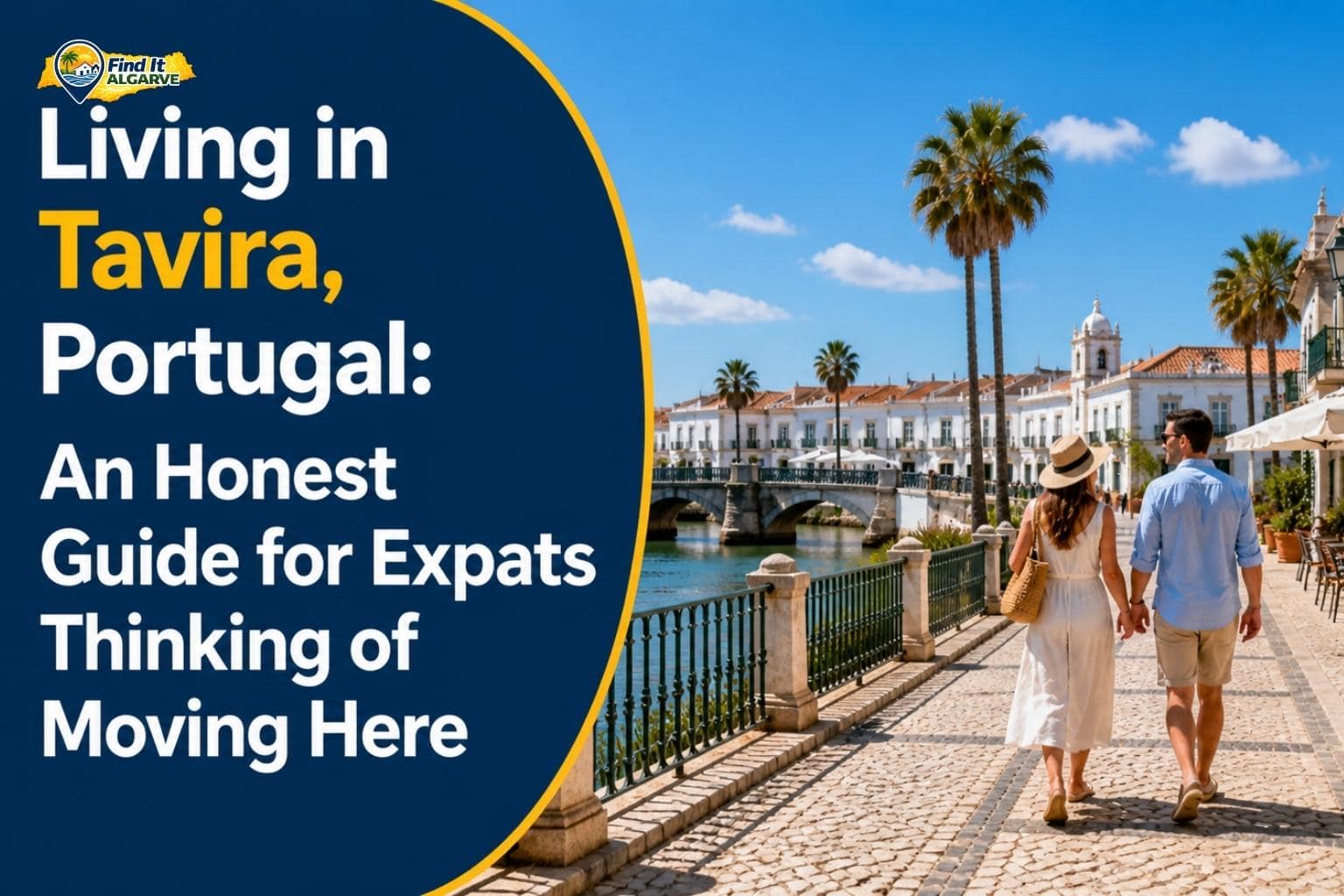
Of all the towns in the Algarve, Tavira is the one that tends to surprise people most. You arrive expecting another tourist-heavy coastal town and instead find a place that feels genuinely, quietly Portuguese. A Roman bridge over the Gilão river, narrow cobbled streets, white cube houses with distinctive pyramid-shaped roofs, a proper covered market, orange groves on the edge of town. It does not try to impress you. It just is what it is.
That quality is exactly why expats who find Tavira tend to stay. Living in Tavira means trading the busier western Algarve for something slower, more authentic and, in many ways, more satisfying for the long term. This guide covers what life here actually looks like.
Where is Tavira and what kind of place is it?
Tavira sits in the eastern Algarve, about 30 kilometres east of Faro and 50 kilometres west of the Spanish border. It is a town of around 28,000 people in the municipality, with a proper town centre, a working fishing harbour and all the infrastructure of a place that functions year round rather than just in summer.
Unlike much of the central and western Algarve, Tavira has strict building regulations that have kept the skyline low and the architecture consistent. There is no overdevelopment here. The town genuinely looks and feels like a historic Portuguese town because it is one, and that is not something you can find everywhere along the Algarve coast.
The beaches are reached by a short ferry ride from the town to Tavira Island, a long barrier island that forms part of the Ria Formosa Natural Park. The beach on Tavira Island is beautiful, clean and considerably less crowded than the main western Algarve beaches in summer. Cabanas de Tavira, just east along the coast, has its own beach that has been recognised as one of the cleanest in Europe.
Who lives in Tavira?
Tavira has one of the most genuinely international expat communities in the Algarve. British, Irish, German, French, Dutch, Swedish, American and Canadian residents have all settled here in significant numbers. It skews slightly older than Lagos — the dominant demographic is retirees and semi-retirees who came for the authenticity, the pace and the price point. But remote workers are arriving in growing numbers and the mix is broadening.
The Tavira Expats network is active and well organised, running regular coffee mornings, hiking groups, social events and activities that make it genuinely easy to meet people when you first arrive. This matters more than people realise in the early months of a move. The community here has a settled, mature feel rather than the transient energy of a more tourist-oriented town. People who move to Tavira tend to stay.
English is widely spoken in the town centre and most everyday needs can be met without Portuguese. That said, Tavira has a larger proportion of local Portuguese residents than many Algarve towns, which means learning some of the language is both easier here and more rewarding than in places where everyone defaults to English.
The cost of living in Tavira
Tavira is notably more affordable than Lagos, Vilamoura or the golden triangle area. This is one of its main draws for expats who want Algarve quality of life without paying a premium for a postcode.
Rent for a one-bedroom apartment in the town centre typically runs €700 to €950 per month on a long-term lease. A two-bedroom apartment is usually €900 to €1,300. Three-bedroom houses start from around €1,100 to €1,500. These are meaningfully lower than comparable properties in Lagos or Albufeira.
Groceries are broadly similar to the rest of the Algarve. Shopping at the local supermarkets, a couple can eat well for €280 to €380 per month. The covered market in the town centre is excellent for fresh fish, produce and local goods at very good prices and is a genuine pleasure to use.
Eating out in Tavira is good value. A lunch menu at a local restaurant runs €8 to €11. A coffee is around €0.80. An evening meal for two at a decent restaurant costs €35 to €55. Seafood is the obvious choice and the quality here, as a genuine fishing town, is excellent.
Utilities for a typical apartment run €75 to €110 per month. The eastern Algarve tends to be slightly windier and cooler in winter than the west, which keeps air conditioning costs down compared to hotter inland areas.
A couple living comfortably in Tavira can realistically budget €2,000 to €2,800 per month including rent, which is significantly less than the equivalent in Lagos or the golden triangle. Our full Algarve cost of living guide gives the broader context.
Property prices in Tavira
Tavira is more affordable than the western and central Algarve but prices have risen over the last few years as its reputation among international buyers has grown.
A one-bedroom apartment in or near the town centre typically starts from around €180,000 to €250,000. A two-bedroom apartment runs €250,000 to €380,000. A three-bedroom townhouse in the old town starts from around €350,000 and rises considerably for renovated properties with character. Properties further out or with sea views at Cabanas de Tavira command a premium.
The old town is the most sought-after area for buyers who want character and walkability. Santa Luzia, the fishing village just west of town known as the octopus capital of the Algarve, has some of the most expensive waterfront property in the area. The rural inland area around Tavira offers better value for those who want more land and privacy.
Our guide to buying property in the Algarve covers the full buying process, the 2026 tax rules and what every foreign buyer needs to budget for.
Getting around from Tavira
Tavira is walkable within the town centre but a car is useful for anything beyond it. Faro airport is about 30 minutes west along the A22 motorway. The train line runs west to Faro and east toward Spain, which is convenient for airport trips and day trips but does not replace a car for general Algarve life.
The A22 tolls apply for motorway travel. Our driving in Portugal guide covers the toll system, Via Verde and what you need to know about driving here as an expat.
Healthcare in Tavira
Tavira has a health centre for SNS public healthcare access and there are English-speaking staff available. The nearest main hospital is in Faro, about 30 minutes away. Most expats in Tavira combine SNS registration with private health insurance for faster access to specialists. The healthcare guide covers this in full.
Schools in Tavira
For families, Tavira’s school options are more limited than the central Algarve. The main international school option most English-speaking families use is Colégio Santiago Internacional, a bilingual English and Portuguese school in the eastern Algarve. For a broader range of international schools including the British curriculum options, families sometimes look at schools in the central Algarve with bus routes that reach the east. Our guide to international schools in the Algarve covers the full picture.
What Tavira is genuinely great for
Tavira is exceptional for people who want authentic Portuguese life rather than a resort experience. The town has real character, real history and real Portuguese culture that has not been polished away for tourist consumption. The food scene is excellent, the beaches are beautiful and uncrowded, and the community is warm and well established.
It is also notably safer than most comparable towns. Crime rates are well below national averages. Walking alone at night is entirely comfortable. This matters to a lot of people considering a move and Tavira consistently scores very well on safety compared to busier Algarve towns.
The price point is genuinely attractive compared to the western Algarve. You get a lot of quality of life for the money here in a way that is harder to find in Lagos or near Vilamoura.
What Tavira is less ideal for
Being honest about it — Tavira is further from Faro airport than Lagos or Albufeira, which matters if you travel frequently. The 30-minute drive is manageable but it is worth factoring in.
The restaurant and nightlife scene, while good, is smaller than Lagos. If you want a lively social scene with lots of bars and late nights, Lagos suits that better. Tavira’s energy is calmer and more local. Most people who choose Tavira have specifically decided that is what they want.
For families, the international school options are more limited than in the central Algarve. This is worth researching carefully before you commit to the area.
Is Tavira right for you?
Tavira suits people who want the real Algarve rather than the resort version of it. It suits retirees who want a settled, international community in a beautiful and affordable town. It suits people who value authenticity, good food, uncrowded beaches and a pace of life that feels genuinely sustainable long term.
If you are weighing Tavira against other Algarve towns, our guide to the best places to live in the Algarve compares the main options across the region. And if you are ready to start planning the practical side of your move, our complete relocation guide and D7 visa guide are the places to start.